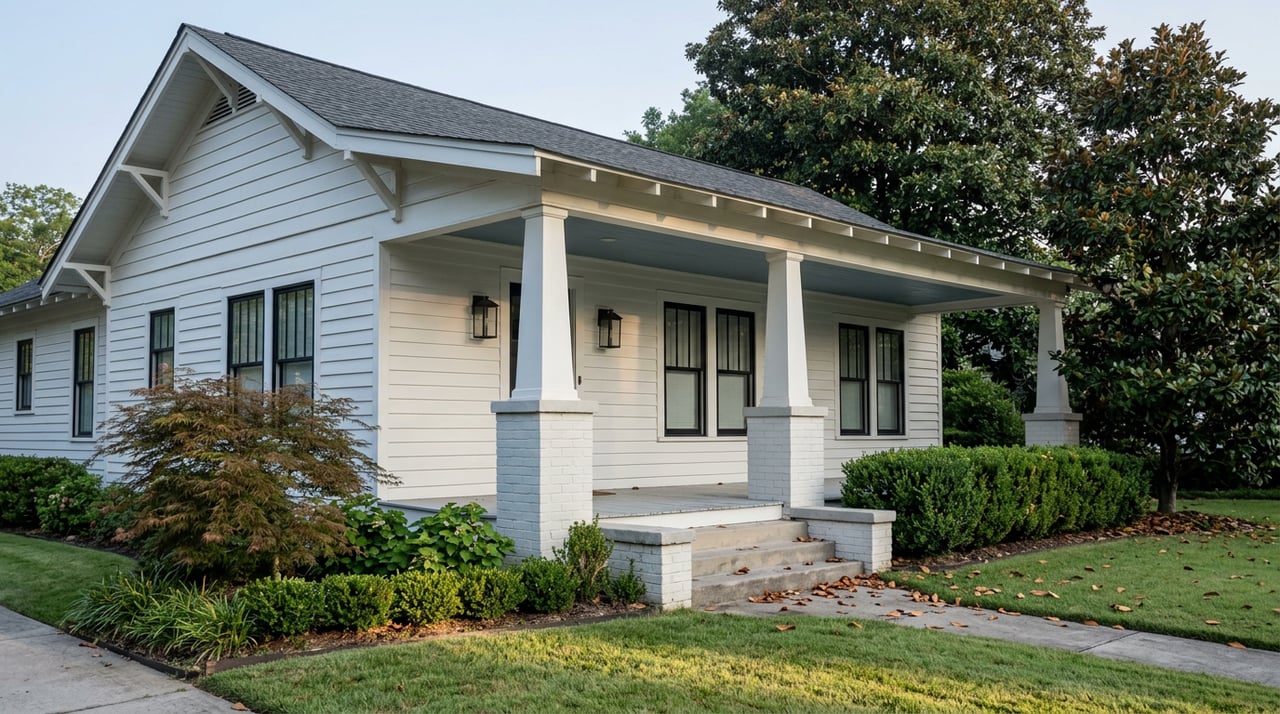
North Highland Avenue's Missing Link Just Closed. Here's Everything That Rushed In Behind It.
September 24, 2026
September 24, 2026
Walk the stretch of North Highland Avenue between Ponce de Leon and University Drive right now and you'll notice things that weren't there a year ago: open parking spots where meters used to sit, construction fencing wrapped around a building at 780 North Highland, and a "coming soon" sign on the corner that used to say Farm Burgers. None of these are unrelated. They are the same story, told four different ways.
For more than a decade, Virginia-Highland's northern retail corridor was quietly held back by two connected problems: a physical gap that kept Beltline foot traffic from flowing into the neighborhood, and a parking policy that made a quick stop feel like a hassle. Both of those problems got fixed within months of each other. What's happened since is not a coincidence. It's what happens when a neighborhood removes the friction that was suppressing it, and the money notices fast.
Start with the part of the story that residents lived through directly. For years, the space that used to house J&J Bourbon Bar at North Highland and St. Charles sat dark, one of several vacant storefronts clustered around the Atkins Park Neighborhood Commercial District. Business owners in the area had a consistent theory about why: parking meters.
Braxton Alexander, floor manager at The Dirty Tea on St. Charles Avenue, put it plainly to local reporters last September when he called the meters "a big deterrent." The Virginia-Highland District Association and the Virginia-Highland Civic Association agreed, and alongside Atkins Park business owners, they asked the city to act. Atlanta City Councilmember Alex Wan sponsored a resolution arguing the district's metered enforcement had become a "one-size-fits-all system that does not appear to take neighborhood-specific context or off-street parking availability into consideration." The City Council voted unanimously in September 2025 to strip the meters entirely, putting Atkins Park on the same free-parking footing as the neighborhood's other two commercial nodes.
That vote mattered on its own. It mattered more once the second half of the equation clicked into place a few months later.
Since the Eastside Trail's first two-mile stretch opened back in 2012, there had been a planned but unbuilt connection linking the trail directly to Ponce de Leon Avenue near Ponce City Market, at the northwestern corner of the Ponce-Beltline bridge. That corner sits at Virginia-Highland's southwest edge, where the neighborhood, Poncey-Highland, and Midtown all meet, and it had been treated as an afterthought for so long that longtime residents stopped expecting it to happen.
It happened in January 2026. After more than two years of active construction and over a decade in planning, the fencing came down around a new steel ramp and stairway connecting the trail straight down to Ponce de Leon Avenue, similar in design to the Edgewood Avenue ramp that links Old Fourth Ward to Inman Park. The surface is poured concrete instead of serrated metal, a small detail added specifically to spare dogs' paws on the walk down.
The practical effect: Beltline traffic headed toward Virginia-Highland from the south no longer has to detour around Ponce City Market to reach the neighborhood's edge. Runners, cyclists, and dog walkers who used to bypass the corridor entirely now have a direct line into it.
Here's how the last twelve months line up:
| Date | What Changed | Why It Mattered on the Ground |
|---|---|---|
| September 2025 | City Council votes to remove all parking meters from the Atkins Park Neighborhood Commercial District | Puts Atkins Park's businesses on equal footing with the corridor's other two shopping nodes for the first time |
| January 2026 | A new ramp connects the Beltline's Eastside Trail directly to Ponce de Leon Avenue | Trail traffic no longer has to route around Ponce City Market to reach the neighborhood's southwest edge |
| March 2026 | Third & Urban announces a $3 million-plus redevelopment of 780 North Highland | First major reinvestment in the corridor's most vacancy-prone stretch in years |
| May 2026 | 26th Street Partners, the firm behind Krog Street Market, pays $17.3 million for two Virginia-Highland retail strips | Outside capital starts treating the corridor's fundamentals as durable, not temporary |
| Spring 2026 | So. Fox opens at 1017 North Highland, the former Farm Burgers space | A hundred-year-old corner lot returns to active use under a known local team |
Four separate announcements, four separate outlets covering them, and almost nobody connecting the dots in real time. Read together, they describe a single mechanism: remove the access barrier, and the capital that had been sitting on the sidelines moves in.
The clearest evidence of that shift is what's happening at 780 North Highland. In March 2026, real estate firm Third & Urban unveiled plans for what it's calling the Atkins Park Collection, a multi-block retail assemblage covering more than 61,000 square feet, with new facades, a landscaped courtyard, and streetscape upgrades. Bridger Properties has signed on as the leasing partner, and construction was slated to begin in late spring.
What's notable is how the developer framed the project. Third & Urban co-founder Hank Farmer described the intent directly: "Many of these businesses are homegrown with roots planted deep in the community." The company has said it's coordinating with the Virginia Highland District nonprofit on safety and activation, and that it's aiming to recruit tenants who complement the corridor's long-standing operators rather than displace them. Whether that promise holds is something residents will judge over the next year or two, but the stated approach, a tune-up rather than a teardown, tracks with how the rest of the corridor's investment has unfolded so far.
It also isn't happening in isolation. Two months later, in May 2026, the investment firm behind Krog Street Market, 26th Street Partners, paid $17.3 million for two segments of Virginia-Highland retail space housing tenants including Kinship Butcher & Sundry and Mali Restaurant. That's outside capital, from a firm with a track record turning industrial buildings into food halls, deciding the corridor's underlying real estate is worth owning. Money like that doesn't move on vibes. It moves when the access math changes.
Then there's the corner most residents will actually walk into. Farm Burgers closed its doors at 1017 North Highland at the end of 2025, ending its run at one of the neighborhood's most storied lots. Building owner Lynn Dewitt described the site's history when the next tenant was announced: "This main corner lot has been serving the Virginia-Highland community in a variety of ways for 100 years." It started as a Standard Oil filling station, later became Herrington Service Station, and eventually converted into a restaurant destination while keeping its original architectural bones.
The next chapter belongs to Myles Moody and Rachael Pack, the husband-and-wife team behind Kinship Butcher & Sundry a few doors down. Their new concept, So. Fox, short for Southern Fox, a nod to the Muscadine grape native to the region, is a 50-seat, wine-forward restaurant built around a natural wine program and a hyper-seasonal, à la carte menu focused on local proteins and produce. The opening was targeted for spring 2026. If that timeline held, the corner has already reopened by the time you're reading this, which means one of the corridor's most historically significant lots is active again for the first time in over a year.
None of these four developments would mean much filed separately under "new restaurant," "parking news," and "trail update." Together, they describe a corridor that spent a decade underperforming its own foot traffic potential, not because the shops or the streets changed, but because getting to them was harder than it needed to be. Once the ramp closed the physical gap and the meters stopped taxing every quick errand, the businesses that had been surviving on thin margins for years suddenly had a reason to expect better months ahead, and the capital that tracks those signals showed up within weeks.
If you already live in Virginia-Highland, the practical takeaway is simple: the corridor between Ponce and University Drive is worth walking again, not just for the restaurants you already know, but for what's opening on the corners you'd stopped checking. The neighborhood didn't get a facelift handed to it. It got its bottleneck cleared, and everything else followed the logic you'd expect.
At SET Real Estate Group, we track these shifts because they shape daily life in Virginia-Highland long before they ever show up in a listing. If you're curious how corridor-level changes like these are showing up in the neighborhood's home values, or you just want a local read on what's coming next, reach out anytime.
Stay up to date on the latest real estate trends.

Explore the Best Country Clubs in Brookhaven, GA and Nearby for Golf, Dining, and Private Amenities.

There are over 70 of them in the city, with each having its own unique feature to set it apart.

Why a Newly Built Property Can Fit the Way You Live Today.
A Design Approach That Respects Original Detail in Brookhaven's Landmark Estates.
At SET Real Estate Group, they are passionate about helping clients fulfill their real estate goals. As a team, they don't look at every sale or purchase as just another transaction, but as opportunities to cultivate lasting and meaningful relationships with each of their clients.